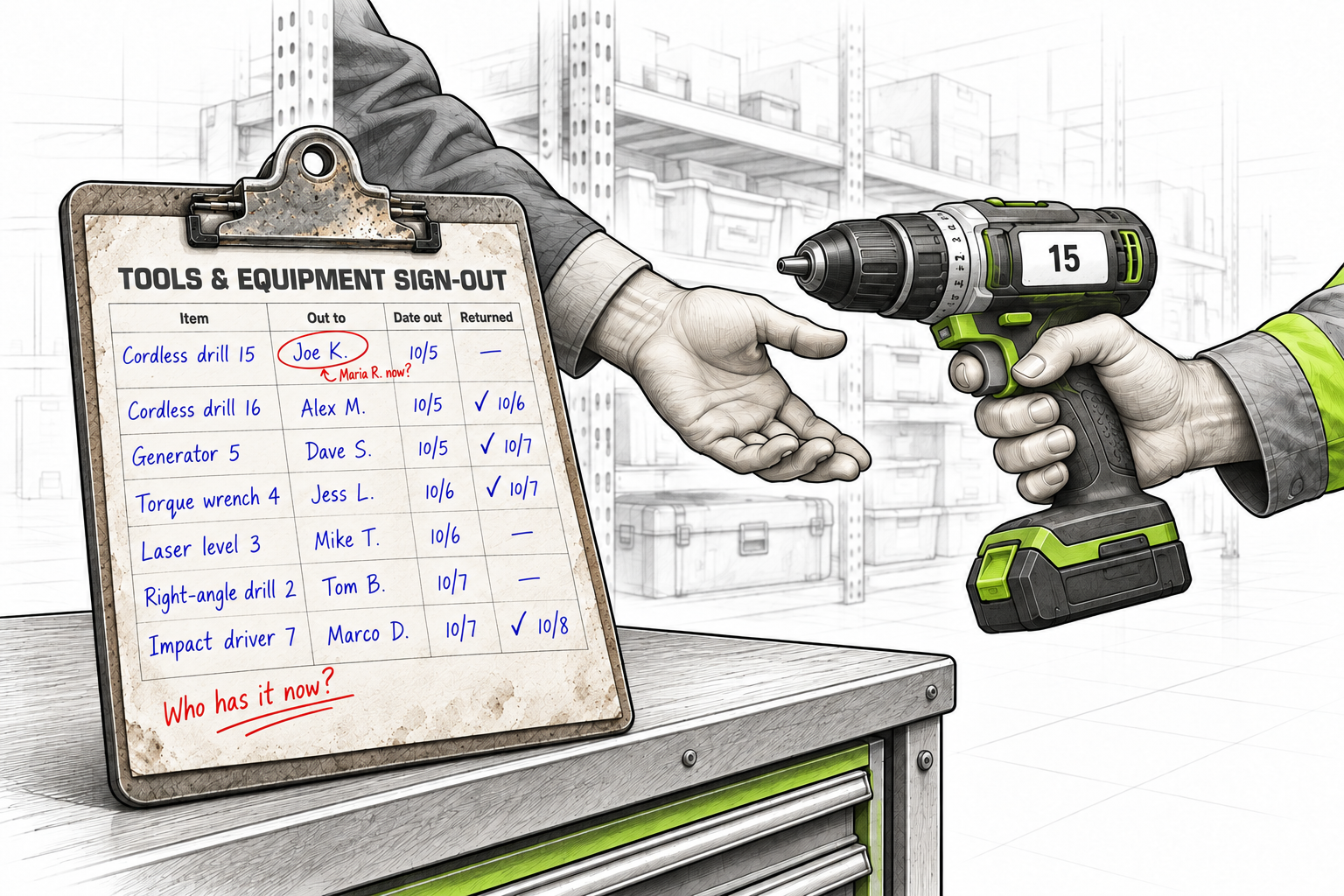
Joe checks out cordless drill 15 on Monday. His name goes on the sign-out sheet, along with the date it should come back.
On Wednesday, another crew needs it. Joe hands it to Maria so they can finish their work. The job keeps moving, but the sheet back at the stockroom still says Joe has the drill.
By Friday, someone else needs it. A supervisor calls Joe, who points them to Maria. Maria is busy, so they leave a message. Meanwhile, someone checks the truck.
The drill isn’t necessarily lost. Finding it just takes more work than it should.
The same problem can happen with a laptop reassigned to another employee, equipment sent to a repair vendor, or inventory passed between locations. The physical hand-off happens, but the tracking record doesn’t keep up.
Teams fill that gap with spreadsheets, notes, whiteboards, and messages. Those workarounds help people get through the day. But when answering “who has it?” regularly requires asking around, the workaround starts taking time away from the work it was meant to support.
Where the workaround starts to struggle
A sign-out sheet can work well when an item goes to one person and comes straight back. A spreadsheet can be useful when a small team keeps it current.
The difficulty grows when items move between people, departments, vehicles, sites, or outside organizations.
Someone has to remember the hand-off, find the right record, and update it. If that update waits until the end of the day, the next person looking for the item may already be working from old information.
Another common approach is to put a person’s name into a location field. “Joe’s truck” gives the team a clue about who has something. But what happens when Joe hands it to Maria and it stays at the same jobsite? Or when the item belongs to a customer?
One field starts carrying several different meanings. People learn how to interpret it, but that understanding may depend on knowing the shorthand or asking the person who created it.
These workarounds reflect people trying to make the available system fit the way their operation works. Think about the last time someone asked who had an asset or whose inventory was sitting in your building. Could your team answer from the record, or did the answer depend on messages, memory, and someone walking out to look?
Ownership, custody, and location are different facts
- Owner: Your company.
- Custodian: Maria, who currently has responsibility for it.
- Location: The job site.
When Joe hands the drill to Maria, custody changes. Ownership stays the same, and the location might stay the same, too.
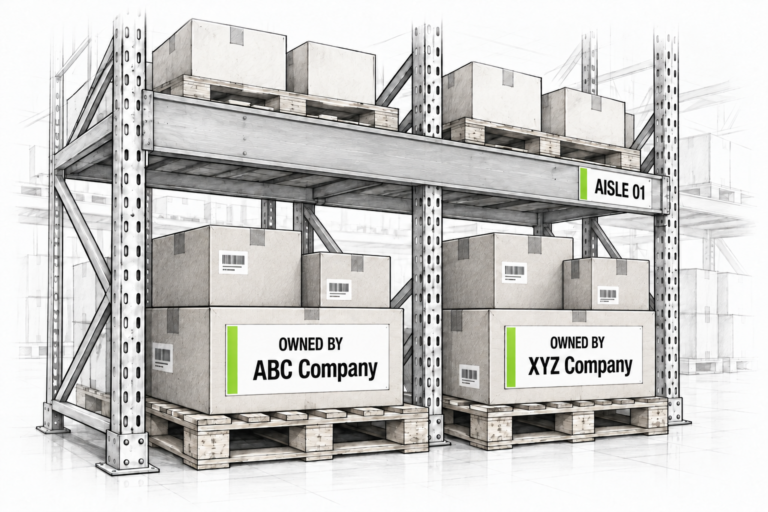
Now consider customer-owned inventory stored in your warehouse. Your team holds it, but it belongs to someone else. A shelf location alone doesn’t tell you which stock is yours and which belongs to the customer.
Equipment sent out for repair presents another variation. You still own it, while the repair vendor has it.
Keeping these facts separate makes the record more useful. It helps answer questions about responsibility, customer property, and availability without requiring someone to reconstruct the situation from notes.
How Panatrack keeps those answers together
Panatrack ST provides cloud tracking for assets, tools, equipment, parts, and job inventory. It tracks ownership, custody, location, and status, and can run independently or alongside an ERP.
Those details belong to the same operational record, so your team can understand who owns an item, who has it, where it is, and what is happening to it.
For cordless drill 15, that starts at checkout. Joe’s assignment and the expected return date are recorded. When he hands it to Maria, a custody transfer can be recorded through the mobile app in the field. When it comes back, the check-in is recorded as well.

Barcode scanning helps identify the item involved, and transaction history provides a record of the checkout, transfer, and check in. The next person looking for the drill can check its recorded custodian and location instead of starting with the original sign-out sheet.
The broader ownership distinction matters just as much. Customer-owned stock can be identified by its owner even while your organization holds it. Recording a change in custody doesn’t have to mean that the item was sold or that ownership changed.
The workflow depends on what you’re tracking. A returnable asset needs different handling from inventory that will be used up. The goal is to represent those differences while keeping the information connected and accessible to the people who need it.
What would you do with that time back?
Searching for an item costs more than the minutes spent looking.
A supervisor stops planning to make calls. A warehouse employee leaves receiving to check another area. A technician waits for equipment before starting a job. Someone researches a replacement because the item can’t be located when it’s needed.
When records stay current, a quick lookup can replace much of that searching and coordination. People can start with the recorded location and custodian, then arrange a hand-off with the right person.
That visibility can also help prevent unnecessary purchases. Before ordering another asset or replenishing stock, your team can check what is already held elsewhere in the operation. You may still need to buy more, but the decision can be based on a clearer picture of what you have.
You don’t need to assume a savings percentage to assess the potential value. Start with your own experience: how often does someone search for an item, how many people get pulled into the search, and how often does uncertainty lead to another purchase?
Less time spent chasing information means more time for receiving, maintenance, job preparation, customer requests, and the other work your team needs to finish.
If your team has developed a workaround to answer those questions, we’d like to hear it.
The broader ownership distinction matters just as much. Customer-owned stock can be identified by its owner even while your organization holds it. Recording a change in custody doesn’t have to mean that the item was sold or that ownership changed.
The workflow depends on what you’re tracking. A returnable asset needs different handling from inventory that will be used up. The goal is to represent those differences while keeping the information connected and accessible to the people who need it.
Still relying on a workaround to know who has what? We’d like to hear how your team handles it. Tell us what you’re tracking and where keeping records current gets difficult. We can show you how Panatrack could help your team spend less time searching and more time getting work done.